C) Squares and challenges
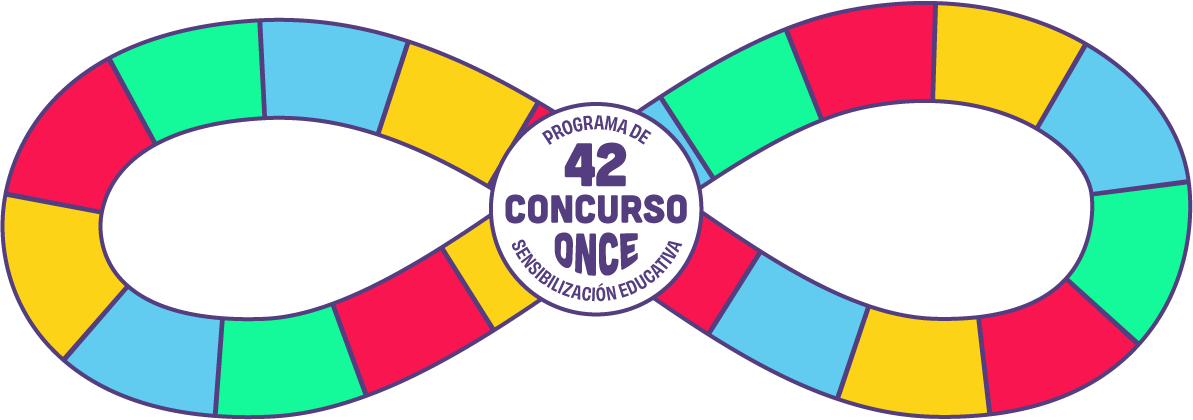
“The Great Accessibility Board” game board consists of squares, with five different types of challenges, a die (you can use an accessible one for students with visual disabilities), and team tokens to advance.
Each square contains an experiential challenge, adapted for easy implementation in the classroom or outside it, which will put students in the shoes of people facing different types of barriers in their daily lives.
Some challenges require classroom materials (pencil cases, backpacks, pencils, etc.) to carry them out.
The squares will also display on-screen real examples of accessible products that address barriers faced by people with disabilities, to inspire students and show them how imagination and creativity are the cornerstones of innovation.
Square colour
Type of challenge on the square
Purple
Squares with challenges related to visual disability
Blue
Squares with challenges related to hearing disability
Red
Squares with challenges related to physical disability
Green
Squares with challenges related to intellectual disability
Yellow
Squares with challenges about everyday barriers that highlight other forms of exclusion or difficulty (allergies, ADHD, Specific Language Impairment, learning difficulties, dyslexia, sensory hypersensitivity, linguistic barriers, as well as mental health issues such as agoraphobia, anorexia, anxiety, depression, etc.)
Multicolour
Monthly challenges with a prize: one challenge for each disability
Each month, the board will feature an activated special square for participating in the monthly challenge, which will focus on each disability: visual, hearing, physical, and intellectual.
To take part, you can upload a video with a maximum duration of 90 seconds from the private teacher area, which shows a barrier related to the disability (visual, hearing, physical, or intellectual) and the solution devised to make life easier for people with that disability.
The structure of the video should include three moments:
-
Barrier Analysis:
Illustrates or presents the challenge or difficulty through an everyday situation. It demonstrates an understanding of the difficulties and challenges faced by people with disabilities.
-
Focus and Empathy:
Presents the situation or challenge, showing the ability to put oneself in others' shoes, highlighting how people with disabilities feel and what they face, and what we can do to facilitate their inclusion in society.
-
Solution Proposal:
Illustrates the idea-solution and its impact on improving the lives of people with disabilities, serving as proof of imagination, creativity, and innovation applied to the solution. It adopts a critical reflection approach aimed at achieving a fairer, more participative, and inclusive society for people with disabilities.